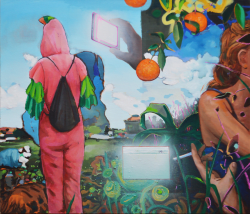
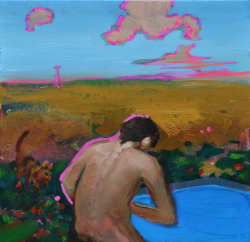
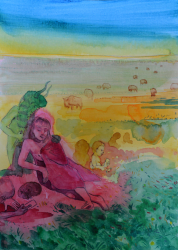
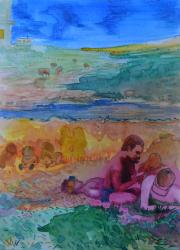
The apocalypse is not the sublime terror of a John Martin painting, all fire and wrathful skies. The apocalypse we are presented with is a little disappointing, like a weekend in the country. The very lightness of the watercolour contributes to the sense of an event that has lost its substance. The sky, a bruised peach colour, bleeds into a sickly yellow horizon, and the pigments stain the paper rather than building a solid world on it. The effect is a landscape from which things have been removed. What is left is a residue, a faded world waiting for nothing in particular.
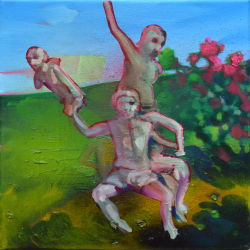
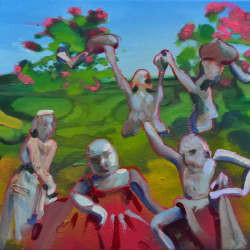
The figures seem to have undergone the same dissolution. Rather than survivors huddled in the ruins, the figures are pink puddles. Rendered in a chemical pink, they seem to be either dissolving into the lawn or, conversely, failing to fully form out of it, and their shapes merge with the formless masses that have populated his recent paintings. The depiction of a strange, empty, modern leisure is an idea he has been approaching for years, present in the uncomfortable gathering of Siesta en el camping, from 2019, or in the more frantic and crowded scene of El fin del mundo, from a decade and a half earlier. Here the figures are no longer people; they are the abstract form of lassitude itself. These figures share a space, but they do not seem to share a reality, a condition that has pursued Moreno Sánchez’s work since early canvases like Transeúntes. A strange ancestor for this painting can be found not so much in the history of apocalyptic art as in the desolate landscapes of the American West after the great bison herds were annihilated in the 19th century. Those images also depicted the end of a world, leaving behind a silent, faded terrain, dotted with proof of what had been lost.