The pastoral, with its language of soft hills and harmony, belongs to a world that may never have existed, and which certainly does not exist now. To draw on that language can only be an act of nostalgia, irony, or warning.
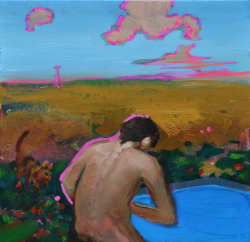
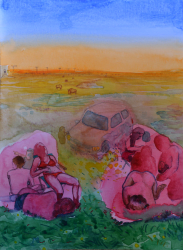
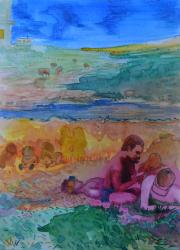
A wash of soft blues and yellows paints a high, clear sky over a wide plain. In the foreground, figures rest wrapped in a haze of pinks and greens, their bodies relaxed, comfortable. In the distance, a herd of bison grazes. The scene is imbued with a deep silence. It gives the feeling of a safe place, a vision of Arcadian calm that echoes his much earlier, more direct works, like Paisaje nostálgico, from 2009. The brushwork is soft, the colours blending into one another.
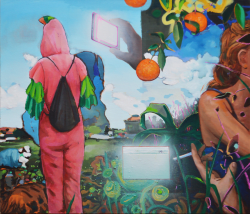
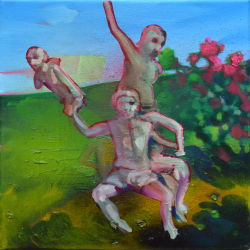
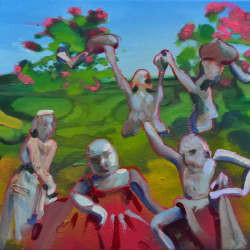
And then the painter gives it a name: El auge de la ultraderecha. The title falls on the image like a judgment, an external force that does not describe the scene, but infects it. This act of violent naming is a constant strategy in the work of Moreno Sánchez. A smiling victim in a cooler is titled Crimen en el olivar; an anodyne view of some tents, EL apocalipsis se parece a un camping. The act of naming is an instruction to look again. Each element is forced into a new, sinister register by this collision.
This way of working is an argument with a long artistic tradition. In a painting like The Harvesters, by Pieter Bruegel the Elder, from 1565, the world is stable. The heat, the work, the shared rest, the vast expanse of the land: everything adds up to a coherent vision of a divinely ordered, if exhausting, reality. Everything has its place. Moreno Sánchez’s watercolour, by contrast, is a painting about a world falling apart.