Every living being occupies its own reality. For the baby, mouth open in a perfect circle of need, the world is nothing more than sensation, a one-person kingdom. Above, a cat sits, very tense, its gaze fixed on something outside the frame, its attention entirely elsewhere. A second cat investigates the folds of a blanket, absorbed in its own private hunt. They are models of a pure, unperturbed presence. The adults, visible only as a hand, a hip and a pair of feet, are a landscape of flesh. The scene marks a radical departure from the silent, devotional dyad of his earlier Maternidad from 2011. A dozen years and a world of experience have passed.
This kind of domestic chaos has a long history. A painter like the 17th-century Dutchman Jan Steen would fill a room with disarray. His noisy households are scenes of human failure. Moreno Sánchez’s canvas does not mean to teach a similar lesson. The chaos here is biological, not moral. No one is misbehaving; they are simply being, their natures running in parallel, their needs conflicting. The baby cries because that is what babies do. The cats watch and prowl because that is what cats do.
The painting itself conveys that sense of competing information. The emerald green of the sheet and the loud paisley print of the duvet fight for dominance, a visual noise that threatens to devour the figures.
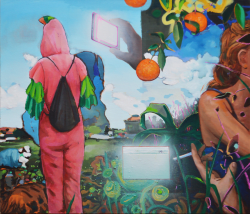
Unlike so many of his recent works, which find their strangeness in the algorithmic, machine-generated bodies, this painting’s power comes from its intense, almost brutal familiarity. The subject is not a glitch in a latent space, like the figures in Jardín triturado, but a crisis happening in a bedroom.
The little picture: a reference to Raffi’s Baby Beluga.