Ángel I.

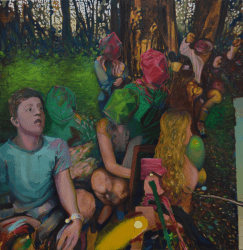
2024, Oil on wood, 30 x 30 cm.

An Angel, Assembled

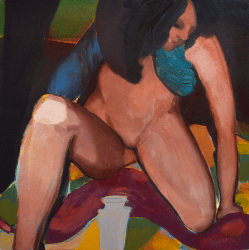
Here is a body, but not a person. A torso, rendered in warm, fleshy pinks, raises its arms in a gesture that is half surrender, half celebration. Here are clothes, but not a costume. A bolt of brilliant magenta cloth is cinched at the waist by a sash of electric, impossible blue, pooling on the floor in a theatrical crumple. Here is a wing, but not a flight. It rests beside the figure, a separate object, its white feathers tipped in a gold that rhymes with the hazy light caught in a glass bottle nearby. This is a scene of parts, a collection of studio props. The title tells us this is Ángel I, the first in a series. But it feels less like a finished angel and more like the moment before the show begins, the quiet inventory of what is needed to construct one.

Juanma Moreno Sánchez has long been fascinated by the machinery of belief and the grand symbols of the Western canon, especially those of his native Spain. His catalogue is populated with Assumptions, Pietàs, and Madonnas, as in the pair of canvases from 2020, Madonna (I) and Madonna (II). Yet his treatment of these subjects is never straightforwardly pious. It is painterly, which is to say it is skeptical, curious, and deeply invested in the physical stuff of the world. He seems to ask what these ancient images do now, in an age of digital saturation. What happens when an artist known for his 2017 painting, El funeral del influencer, turns his attention to the celestial? The answer in Ángel I is that the sacred is brought down to the level of the studio floor. The angel is not a visitor from another world, but a problem of assembly, a challenge of color and form, to be solved with oil on wood.

The arrangement feels like a direct, almost mischievous, conversation with the Spanish Baroque, particularly with a painter like Francisco de Zurbarán. In a work like A Cup of Water and a Rose (c. 1630), Zurbarán could take the most humble objects—a ceramic cup, a single flower—and, through the intensity of his gaze and the alchemy of his light, elevate them into subjects of profound spiritual contemplation. Moreno Sánchez reverses this operation. He begins with a subject of ultimate transcendence, an angel, and places it among the mundane clutter of the present. The wing is an accessory. The body is a fragment. The bottle, with a stick balanced on its mouth, is a stubborn, earthy fact that refuses to be ignored. The painting does not ask us to look through the objects to a higher reality; it asks us to look at them, at the gorgeous friction between a symbol and its shabby, provisional parts.

This pile of parts has its own contemporary resonance. In her 2009 essay "In Defense of the Poor Image," the artist and writer Hito Steyerl wrote about the life of images in the digital age. She describes the "poor image" as a low-resolution copy that has been passed around, compressed, and degraded, losing its original quality but gaining a new kind of velocity and presence. It is "a ghost of an image, a preview, a thumbnail, an errant idea." The idea of an angel is, in many ways, our culture’s ultimate poor image: a concept reproduced so many times, in so many forms from high art to kitsch, that it arrives to us pre-worn, loaded with a dubious genealogy. Moreno Sánchez takes this ghost and gives it a body, albeit a constructed one. He works with images that may be inspired by generative artificial intelligence, as noted in his 2024 exhibition "El Valle Inquietante" (The Uncanny Valley), a show that explored the unsettling terrain between the familiar and the strange, the human and the algorithmic. This painting’s angel is not the pristine original, but the fifth-generation copy, lovingly rendered back into substance, its digital blurriness given the weight and texture of oil paint.

So what is being assembled here, in this dark, undefined space? Not just a figure, but an argument about where the sublime can be found today. It may not arrive as a seamless, awe-inspiring vision. It may instead look like this: a handful of props, a beautiful mess, an act of making-do. The gesture of the torso is open, receptive. The colors of the drapery are a shock of pure joy. The light on the bottle is a small, contained warmth. The painting does not promise flight. The wing is grounded, for now. Instead, it offers the materials. It suggests that if a miracle is to happen, we will have to build it ourselves, from the radiant and broken pieces we have at hand.

More on 2024